Our secondary analysis of data from the German Child Health Survey (KIGGS) has been published
The vaccination debate is gathering momentum everywhere. Our association, MWGFD e. V., has just successfully submitted a petition to the Bundestag and obtained the necessary quorum of 50,000 signatures, meaning the petition will now be forwarded to the Bundestag’s Petitions Committee. The committee will then decide whether it will be brought before the Bundestag. The aim is to abolish the de facto compulsory vaccination imposed by the Measles Protection Act. This Act stipulates that children must present a measles vaccination certificate or a corresponding certificate of medical exemption in order to be admitted to nursery or after-school care.
In practice, this amounts to compulsory vaccination, because, on the one hand, certificates of medical exemption are not easy to obtain – doctors are feeling increasing pressure. On the other hand, such certificates are not always accepted. As a result, parents and children find themselves under pressure as well.
Against this background, our recently published study may be helpful. In this study, we reanalysed data from the German Child Health Survey and asked: Are vaccinated children healthier?
This survey was a representative survey conducted by the Robert Koch Institute in 2007 [1, 2]. It was a meticulous cross-sectional study in which children up to the age of 17 and their parents were interviewed. A computer-assisted interview with doctors was used to gather information on vaccination status and illnesses, as well as many other variables – a total of 120 variables and 17,460 cases. In an initial analysis published by the RKI [3], the authors concluded that there were no differences in the state of health between vaccinated and unvaccinated children. A few years later, the Arbeitsgemeinschaft Bürgerrecht und Gesundheit (ABUG) e. V. (Workgroup Civil Rights and Health) commissioned me to carry out a reanalysis. I was assisted by my co-author Angelika Müller from the Initiative Freie Impfentscheidung (Initiative Free Vaccination Decision), a data specialist who carefully processed the extensive dataset that the RKI makes available to anyone who requests it.
Method
We used the core modules ‘Health’, ‘Vaccination Status’ and ‘Sociodemographic Data’ for our analysis. The survey was conducted at 167 locations across Germany and captured a representative cross-section of children and adolescents. To correct for possible biases, we used a weighting variable in all analyses. The analysis protocol was formulated and preregistered before the analysis began. Further methodological details can be found in the original publication [4], which was published in Medical Research Archives, the journal of the European Society for Medicine. I am a member of this society.
We used a variable counting the number of vaccinations to define vaccination status. 202 children were unvaccinated, 15,142 children had received at least one vaccination and were classified as vaccinated; data were missing for the remainder. We were therefore able to carry out analyses on 15,344 cases.
The main analysis consisted of a regression analysis. This is a statistical method used to investigate which factors are associated with a target variable. The ‘morbidity score’, derived from the doctors’ diagnoses, served as the outcome variable. In a computer-assisted interview, doctors had diagnosed the presence or absence of a range of conditions in the children:
- Atopic conditions (a category defined by us as the presence of one or more of the following conditions: hay fever, asthma, atopic dermatitis; we used this umbrella diagnosis to reduce the number of models we had to calculate)
- Obstructive bronchitis
- Pneumonia
- Middle ear infection
- Heart disease
- Anaemia
- Diabetes
- Thyroid disorder
- Seizures, e.g., epilepsy
- Scoliosis (i.e., curvature of the spine)
- Migraine
We simply totalled the number of such conditions present per child, thereby obtaining a morbidity score ranging from 0 to 11. We then investigated the extent to which the children’s conditions could be explained by the available data. We took into account socio-demographic characteristics, the parents’ economic status and health behaviour, as well as the infections the child had suffered and the medication they had taken. Finally, we included vaccination status – vaccinated or not, or the number of vaccinations – in the equation.
The idea behind this approach is simple: first, the regression analysis examines how well the children’s health status can be explained by the variables already considered. It then checks whether vaccination status provides any additional statistically significant explanatory power. If this is the case, vaccination status also plays an independent role.
Of all the variables examined, vaccination status is the only one that can be meaningfully interpreted in causal terms, as vaccinations are administered specifically to prevent diseases. Accordingly, we expected a statistically significant negative association with the morbidity score if vaccinations prevent diseases. A statistically significant positive association, on the other hand, would suggest that a higher vaccination status is associated with a higher disease load.
The analysis protocol stipulated that, in the event of a statistically significant result, the individual diseases would subsequently be examined separately.
Results
I will summarise only the most important results here:
Firstly, it is interesting to note that, overall, all infectious diseases occur rarely, with the exception of chickenpox, which affected 73% of all children. Others occur relatively rarely. Measles, for example, affected around 7.2% of all children. The other figures range from 0.9% for hepatitis to a maximum of 25% for Epstein-Barr virus (Pfeiffer’s glandular fever) and scarlet fever. It is also interesting to note that, in every case, the infection occurs even in vaccinated children. It is therefore a myth to say that vaccinated children cannot contract a disease. There are, however, differences in incidence. Vaccinated children are less likely to contract measles, mumps, whooping cough, and rubella. But they are more likely to contract chickenpox, scarlet fever, Epstein-Barr, herpes, salmonella, and hepatitis. For the latter four, the effect is not significant; for all the others, it certainly is.
Lesson number 1: Vaccination offers protection against infection for only a minority of all the diseases studied. For all the others, natural immunity – which unvaccinated children acquire by contracting certain diseases – appears to prevent other illnesses.
This was a simple, univariate analysis. Our main analysis, the regression of the morbidity score, showed that vaccination, as an additional variable with a positive sign, is highly significant in the regression equation. This means that, in vaccinated children, the number of vaccinations contributes to a higher morbidity score: the higher the number of vaccinations, the higher the morbidity score, even when all other important variables are considered. After all, that is precisely what the regression equation does.
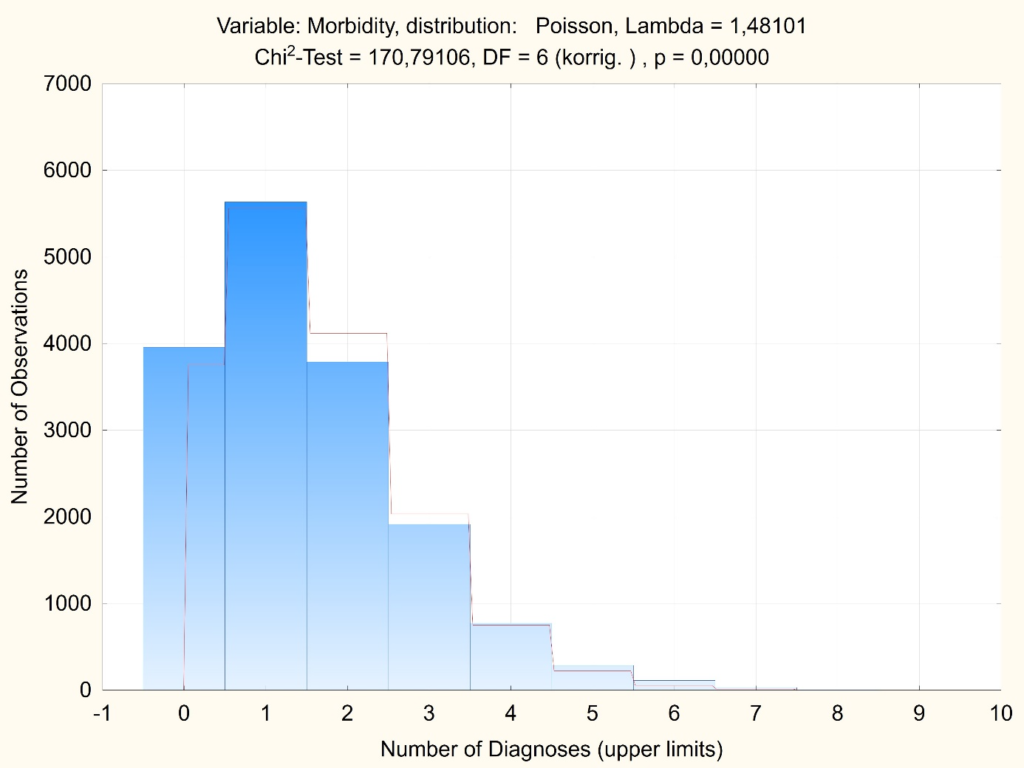
Technically speaking, this was a Poisson regression because the morbidity score, as a count variable, follows a Poisson distribution (Figure). The analysis of the model fit shows that it fits quite well. However, the proportion of variance explained is very small, even though the model is highly significant.
We then investigated the presence or absence of individual diagnoses by calculating a total of 11 logistic regressions. A logistic regression is a regression that models a dichotomous variable – in this case, the absence, or presence of a diagnosis. We found a negative association between the number of vaccinations and otitis media, anaemia and scoliosis. The same pattern held true here: the higher the number of vaccinations, the more likely there was an effect on the diagnosis. Here, too, the effect is small but significant: it stands at 2–3%. (Note for specialists: as the analysis modelled the absence of the diagnosis, the odds ratios in the publication must be interpreted in reverse!)
For these three conditions and the morbidity score, we investigated which vaccinations played what role. This revealed that polio, measles, and hepatitis vaccinations had a positive effect, whilst mumps, diphtheria, tetanus, and Haemophilus influenzae vaccinations had a negative effect. Here, too, the vaccination variables were included after the socio-demographic and health variables; however, the publication only contains the odds ratios for the vaccinations (the full models are presented in the supplement).
Critical analysis
What we can say with some certainty based on this study is that vaccinations do not contribute to children being healthier. We can say this because vaccination can be interpreted as a causal factor. We cannot say whether unvaccinated children are healthier because they are not vaccinated or for other reasons. It is conceivable that the refusal of vaccinations points to an entirely different lifestyle, family dynamic, and communication style, which makes children more resilient.
Why are these vaccinations not associated with better health in children? It could be that vaccine adjuvants – often aluminum oxide – are problematic and place a strain on children, particularly when they accumulate through multiple vaccinations. It could be that the multiple antigens used in combination vaccines are problematic. It could be that naturally contracting certain illnesses is, on the whole, beneficial for the immune systems of growing children. We do not know.
To find this out, a large, longitudinal, three-arm study would need to be conducted, in which children are either vaccinated, receive only the carrier substance including adjuvants but without antigens, or are given a saline solution as a placebo. If such a three-arm study were to be conducted as a blinded, randomised trial over an extended period, we could then determine whether vaccinations have positive or negative effects. And, if the effects are negative, whether they are caused by the adjuvants or by the antigens.
It is, however, sobering to note that no such placebo-controlled study has yet been carried out in Western industrialised countries.
The following findings cannot therefore be readily extrapolated to countries with significantly different living conditions. Conversely, the same applies: findings from many regions of Africa cannot be directly extrapolated to western industrialised countries. For instance, several studies have shown that measles vaccination campaigns have significantly reduced child mortality in many regions of Africa [5]. For other vaccines, however, increased mortality rates have also been reported there [6].
It is possible that the effects of vaccinations against certain diseases in Western industrialised countries differ from those in countries with a higher disease load, due to the living conditions there. However, whether and to what extent this is the case has not yet been investigated by the necessary randomised, placebo-controlled long-term studies.
However, as we have seen, the RKI’s data are not watertight. We have found some indications of implausible data. This is hardly surprising, given the scale of the study. Furthermore, it is naturally difficult to draw conclusions regarding individual vaccinations from a cross-sectional dataset, as the composition of vaccines may have changed over the years – a factor that cannot, of course, be unravelled in a cross-sectional study.
Furthermore, some diseases are very rare, which means the regression estimates may be on shaky ground; the same applies to the impact of certain vaccinations. Whilst our models generally fitted the data very well, distortions cannot, of course, be ruled out.
I also regard the findings of our study as merely a provisional insight. Their purpose should be to finally prompt a large-scale, three-arm, placebo-controlled study by an independent body. For without such a study, any claims in one direction or the other are nothing more than wishful thinking. However, there is one thing we can say with certainty: based on this data, compulsory vaccination – whether de facto or de jure – should by now be a thing of the past for every politician, every public authority and every doctor. Parents can use our data to consider which vaccinations are appropriate for their child. And STIKO, the German Vaccination Commission, should once again thoroughly review its position.
Literatur
- Kurth B-M, Kamtsiuris P, Hölling H, Schlaud M, Dölle R, Ellert U, et al. The challenge of comprehensively mapping children’s health in a nation-wide health survey: Design of the German KiGGS-Study. BMC Public Health. 2008;8(1):196. doi: https://doi.org/0.1186/1471-2458-8-196. PubMed Central PMCID: PMC18533019.
- Kamtsiuris P, Lange M, Schaffrath Rosario A. Der Kinder- und Gesundheitssurvey (KiGGS): Stichprobendesign, Response und Nonresponse-Analyse [The children and health survey (KiGGS): Sampling design, response and non-response analysis]. Bundesgesundheitsblatt – Gesundheitsforschung – Gesundheitsschutz. 2007;50:547-56. doi: https://doi.org/10.1007/s00103-007-0215-9. PubMed Central PMCID: PMC17514438.
- Schmitz R, Poethko-Müller C, Reiter S, Schlaud M. Impfstatus und Gesundheit von Kindern und Jugendlichen: Ergebnisse des Kinder- und Jugendgesundheitssurvey (KIGGS) [Vaccination status and health of children and youths: Results of the children and youth health survey (KIGGS)]. Deutsches Ärzteblatt. 2011;108(7):99-104. doi: https://doi.org/10.3238/arztebl.2011.0099. PubMed Central PMCID: PMC21412506.
- Walach, H., & Müller, A. (2026). Is vaccination associated with better health in children? A secondary analysis using a large cross-sectional survey, the German KIGSS data file (Kindergesundheitssurvey – Children’s Health Survey). Medical Research Archives, 14(7). doi: https://doi.org/10.18103/mra.2026.0360
- Aaby P, Bhuiya A, Nahar L, Knudsen K, de Francisco A, Strong M. The survival benefit of measles immunization may not be explained entirely by the prevention of measles disease: a community study from rural Bangladesh. International Journal of Epidemiology. 2003;32:106-15. PubMed Central PMCID: PMC12690020.
- Aaby P, Mogensen SW, Rodrigues A, Benn CS. Evidence of Increase in Mortality After the Introduction of Diphtheria–Tetanus–Pertussis Vaccine to Children Aged 6–35 Months in Guinea-Bissau: A Time for Reflection? Frontiers in Public Health. 2018;6. doi: https://doi.org/10.3389/fpubh.2018.00079. PubMed Central PMCID: PMC29616207.